
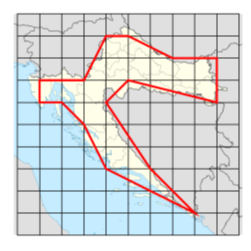
Determining areas of irregular shapes like countries and regions can be complicated. However, a theorem discovered in 1899 by Austrian mathematician Georg Alexander Pick (1859–1942) can help to get simple and good approximations!
To use Pick’s Theorem, one needs a square grid. The area of the smallest square in the grid shall be called the square unit. The set of points of intersections of the lines forming the grid is called a (square) lattice. Pick’s theorem is applicable to any polygonal shape whose all vertices are lattice points – a lattice polygon.
Pick’s Theorem: Given a lattice polygon, let I be the number of lattice points inside the polygon, and B the number of lattice points on its boundary. Then the area A of the polygon is I + B/2 – 1 square units.
Example 1. Assuming the grid consists of unit squares (side length equal to 1), the area of the blue lattice polygon in the picture on the right is 47 + 9/2 – 1 = 50.5 because there are 9 lattice points on the boundary of the polygon (marked red) and 47 lattice points inside.
Example 2. The picture on the top of this page represents the map of Croatia, overlaid with a square grid. The square unit is 2500 km2. The shape of Croatia is approximated by a lattice polygon (red). There are 20 lattice points on its boundary and 12 lattice points inside, so by Pick’s formula its area is 21 square units, i.e., 52500 km2. Note that even if the lattice polygon was not too good an approximation of Croatia’s shape, we obtained a reasonable approximation of the true area (56594 km2).
This Worksheet is part of the Quartely Problem Series. For more quartely problems and other classroom materials, click here.
Picture Source: License CC 3.0 / GNU Free Documentation License, author NordNordWest, published on Wikipedia (https://commons.wikimedia.org/wiki/File:Croatia_location_map.svg).
CC-BY-NC-SA 4.0 licence granted
Content-related competences

