
Basic Information
- Interdisciplinarity: Biology, Chemistry
- Duration: 2 weeks
- Target Age Group: 15–18 years old
- Partners Involved: ICSE, vocational schools Wolfach, nursing home Hausach

Summary
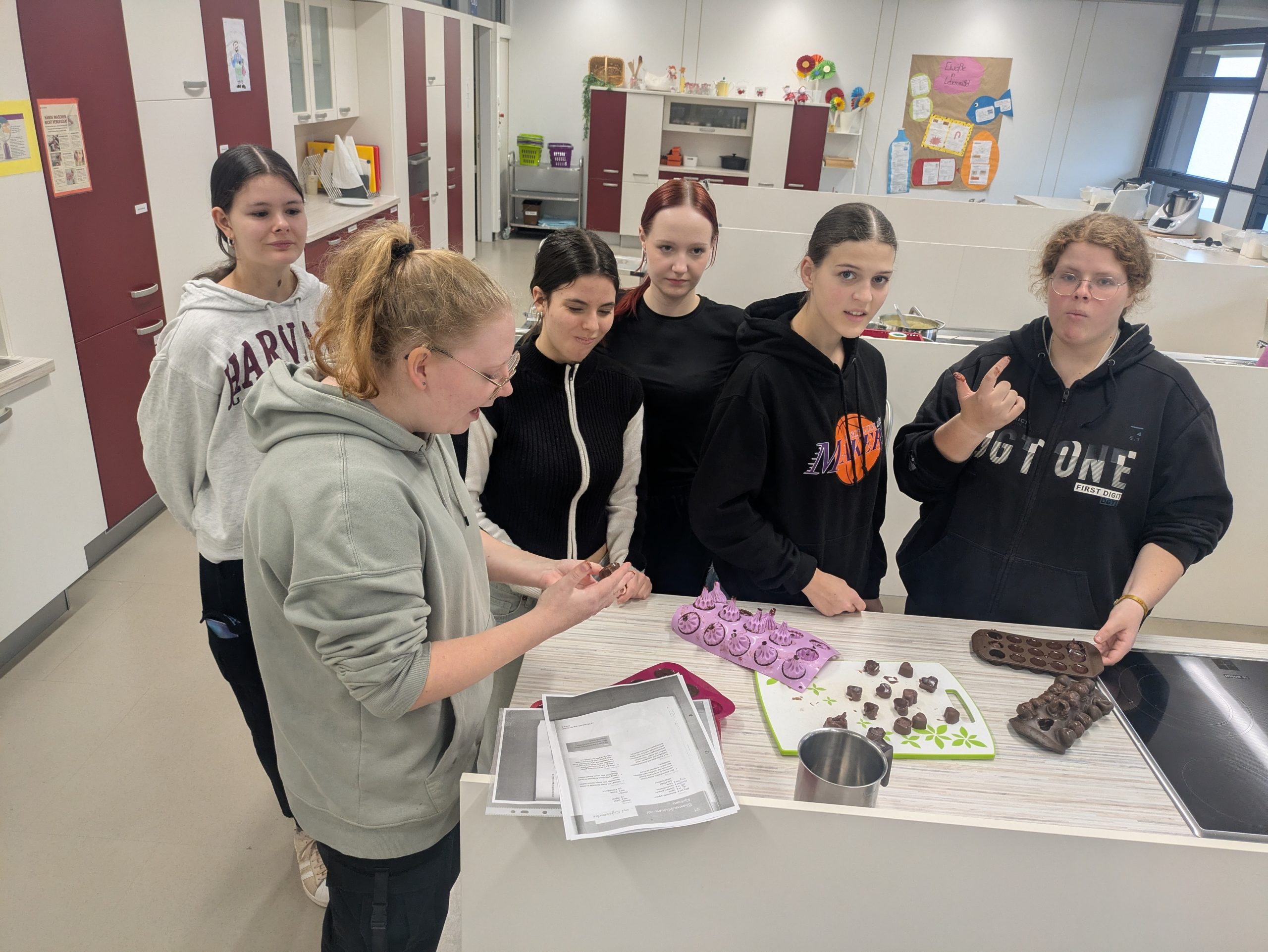
The pupils at BS Wolfach were given an introduction to the topic of “dysphagia” and cooked an adapted menu in the school’s teaching kitchen and later prepared it for residents of a care home. Due to their consistency, these dishes were also suitable for people with swallowing difficulties (dysphagia). They used the methods and means of molecular cuisine for this purpose. The event and the recipes were documented and also presented at the ICSE Science Factory trade fair in Freiburg.
Description of the Activity
The two-year vocational school for home economics at the vocational schools in Wolfach consists of only eight students this school year. Practical food preparation is an important part of their school education. As “special forms of nutrition” are also part of the curriculum, the teacher, Ms Haas, was able to integrate the project well into the lesson plan. The main part of the project, therefore, took place on two Thursday mornings; however, some pupils already had prior knowledge, as they had participated in a project on molecular cuisine during the project days in July 2024. The students were able to work in a well-equipped school kitchen at a professional kitchen level. The components of the meal were divided among the pupils. These components were essentially
Cauliflower soup
Bratwurst
Rösti
Vegan gravy
Soft chocolate
Cinnamon foam
The students prepared these ingredients in pairs, depending on the amount of work involved. Essentially, all the ingredients were pureed in intermediate stages and then moulded back into silicone forms with suitable texturisers. The aim was to create a visually appealing menu that conformed to the requirements of the disease.
After the test cooking on the first date, the quantities were increased on the second date. At the same time as cooking, a beautiful table was set so that the senior citizens, who were brought by minibus, also had an attractive setting. The students made every effort to prepare and serve the food as attractively as possible.
The students presented their designs to the public at the ICSE Science Factory fair on 14.2.25. In addition to a poster with pictures and recipes from the project, visitors also had the opportunity to see a sample plate that was frozen during cooking.
Strategies to win schools
Contact was made via personal contacts. BS Wolfach is the home school of one of our employees, who made contact with the specialist teacher. In our experience, it is easier to convince teachers on a content-related level by discussing what a project could look like in terms of content, rather than focusing on the general concept of Open Schooling. We also promoted the same project through posters, flyers, our newsletter, at a convention with partner schools, and at a public science festival, but nothing came of it. The underlying problem here could be that the majority of grammar schools were approached, whereas home economics and health topics are more strongly represented at vocational schools, as well as at Werkrealschulen and Realschulen, through subjects such as “Home Economics”.
Schools Support
The teacher in Wolfach, Ms. Claudia Haas, is a trained home economist herself and has worked in care homes for several years. As we were able to draw on her knowledge and contacts, ICSE’s contribution in this case was limited to procuring the special ingredients and utensils (binding agents, silicone molds, precision scales, specialist literature). Although one person from ICSE was present at times during the two sessions, they only contributed to the teaching process at the beginning with advisory comments. Arrangements were made with the teacher in advance regarding the menu. Communication took place via email and private telecommunication contacts. Afterwards, Ms Haas and a person from ICSE attended a dysphagia cooking course with a professional chef specialising in this field.
The students’ transportation costs to the trade fair in Freiburg were covered.
Key Success Factors
- The decisive factor for the project’s success was that the topic was well-suited to the type of school and that sufficient time and excellent facilities were available, thanks to its integration into lessons. Thanks to the existing contact with the subject teacher, very efficient and smooth communication was possible. The visit from the nursing home residents made cooking a real event, where each student understood the purpose.
- The students were highly motivated, and the integration into the lessons and contact with the senior citizens meant that there were many different aspects to the project. Both more practical and theoretical students were able to get involved. The visit to the fair was perceived and accepted as an exciting experience.
- The teacher, with whom the project was carried out, found the topic so exciting due to her professional background and previous work in nursing homes that she subsequently took part in a corresponding dysphagia cooking course and brought the pupils to the trade fair in Freiburg as a class, despite the relatively long journey (approx. 100 km).
Challenges
- The questionnaires at the beginning of the project are long, repetitive and too complex for weaker students. This initially makes the students suspicious of the Open Schooling project, as they suspect that the project content may be similarly boring and poorly thought out. We therefore apologized when we handed out the questionnaires and promised that it would be more interesting afterwards. Of course, shorter questionnaires with fewer pointless questions would be better. It’s really shameful to put the students through this!
- Since, at the end of the practical project, really old people with health problems were being cooked for, the work had to be done carefully. Under no circumstances should there be any risk of these people swallowing the food. For this reason, we had already prepared the individual ingredients in the previous week and eliminated any problems.
- Since the pupils tended to be less able young people, the theoretical explanations, for example on a chemical basis, had to be kept at a basic level so as not to frighten the pupils. At the same time, of course, they still had to understand the basics.
- The visit to the trade fair presented a cost issue, which we addressed by assuming control of the event.


Outcomes
- The students were committed to their work, both in cooking and hosting, as well as at the fair.
- Posters were made for the fair, and some of the students were available for interviews at the fair and presented their project there for the ICSE social media channels
- A report on the project was published on the school’s homepage
- A report on the project was published in the official gazette of the town of Wolfach
- A report was published in the regional daily newspaper; another report on the trade fair visit will follow.
- ICSE submitted an article on the project, including recipes, to the German magazine for STEM teachers “MINT-Zirkel”.
- The teacher is definitely interested in further cooperation.
Reflective Remarks
The project worked very well overall, mainly due to the teacher’s commitment and expertise, which enabled them to involve the local retirement home.
A further test is already planned at a vocational college (offering vocational training) for nursing, where samples of the individual binders will also be tested in advance to avoid problems caused by deviating batch properties.
The fair was very well received by the students, probably also because such events seem to be reserved for the grammar school sector, and they were pleased to see that they did not have to lag behind with their results.
The questionnaires are not acceptable in this form; it is not justifiable to issue them in this form.
