Basic Information
- Interdisciplinarity: Chemistry, Biology, Medicine
- Duration: More than 500 minutes
- Target Age Group: 16–17 years old
- Partners Involved: IE-ULisboa, University Nova Lisboa Physics Laboratory, Secondary School of Miraflores
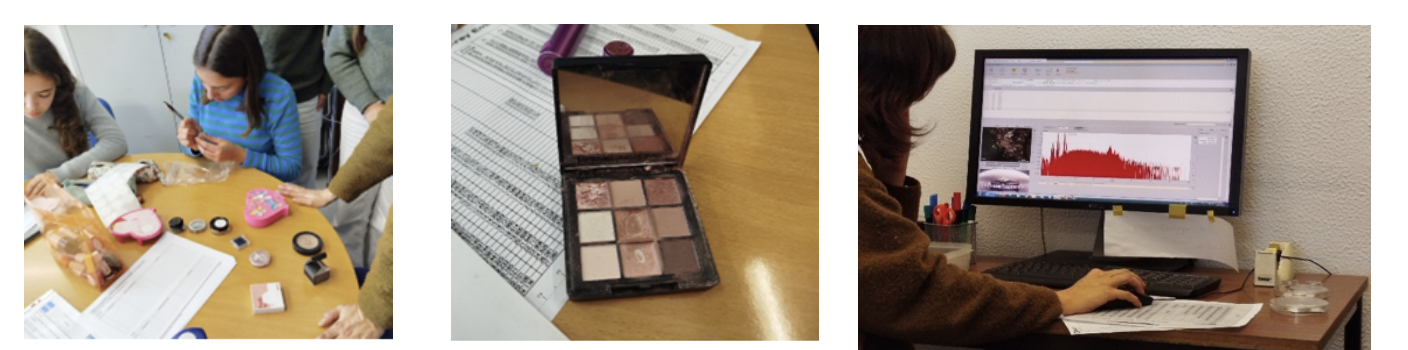
Picture: Sample preparation and analysis.
Summary
This OSA aimed to help students understand analytical chemistry and toxicology through advanced spectroscopic analysis, bibliographic research, and real-world health risk assessment. Students explored the composition and manufacturing processes of cosmetic products, focusing on identifying potentially toxic metallic elements in cosmetics, particularly those designed for children. Using X-ray fluorescence spectroscopy at the University of Nova Lisboa Physics Laboratory, they analysed various cosmetic samples, including eyeshadows, lipsticks, and nail polishes, to detect heavy metals and assess their potential health impacts. The activity promoted critical thinking about consumer safety, environmental health awareness, and advanced analytical techniques, while integrating concepts from Chemistry, Biology, and public health across the 11th-grade curriculum.
Description of the Implementation Phase
Research Phase: The project began in the first academic period with extensive bibliographic research on cosmetic composition and manufacturing processes. Students conducted comprehensive literature reviews that focused their attention on identifying heavy metals in cosmetic products, thereby establishing the theoretical foundation for their investigation.
Partnership Development Phase: Initial contact was established with a member from the Physics Laboratory at the University of Nova Lisboa. Multiple online meetings were conducted during the second academic period to review the analytical technique and methodology, providing students with a theoretical understanding of X-ray fluorescence spectroscopy.
Laboratory Experience Phase: In March, students participated in a university field trip during extra-curricular hours where they familiarised themselves with experimental techniques and conducted multiple analyses. They analysed spectra from various cosmetic products for both children and adults, including eyeshadows, lipsticks, and nail polishes, using advanced X-ray fluorescence equipment.
Data Analysis and Focus Refinement Phase: Due to the extensive results obtained, students decided to focus their study on heavy metals in a specific product category. They selected eyeshadows because they had the most comprehensive dataset across different price ranges and for both adult and children’s use, allowing for meaningful comparative analysis.
Interdisciplinary Integration Phase: Throughout the process, students collaborated with Physics and Chemistry, Biology and Geology teachers from their class and the university researcher to ensure a comprehensive investigation. The project connected curriculum content from Chemistry and Biology.
Communication Phase: The OSA culminated with student participation in the 18th National Congress “Cientistas em ação” (Scientists in Action) on May 10th at Espaço Ciência in Estremoz, where they presented their findings in scientific article format and ran an exhibition stand to communicate results to the broader general and scientific community.
Strategies to win schools
Several strategic approaches were used to ensure successful school engagement and participation. Professional development opportunities were provided to teachers through the ICSE Science Factory Project partnership. Also, the “Cientificamente Provável” program partnership was used, which facilitated access to university-level research facilities and expert mentorship that would otherwise be unavailable in typical secondary school settings. This external partnership was crucial for overcoming equipment limitations and providing authentic research experiences that elevated the project beyond standard classroom activities.
Curriculum integration was carefully planned to align with existing academic requirements, particularly the Curricular Autonomy Domain (DAC) of Physics and Chemistry, which sought to promote interdisciplinary curricular articulation.
The health and sustainability relevance of the project created strong student motivation through its focus on consumer safety and public health protection. The investigation of potentially toxic elements in everyday products that students personally use resonated with their immediate concerns about personal health and safety. The emphasis on children’s cosmetics added an additional ethical dimension that engaged students’ sense of social responsibility. This real-world connection to issues affecting their daily lives and broader society provided meaningful context that sustained engagement throughout the research process, while the opportunity to contribute to scientific knowledge about consumer product safety gave students a sense of authentic scientific participation and civic contribution.
School Support
Comprehensive support was provided to participating schools through various interconnected mechanisms designed to ensure the successful implementation of the project. Specifically, expert mentorship provided by the ICSE Science Factory components from IE-ULisboa formed the foundation of ongoing support. Regular sessions were organised to discuss methodology and address challenges as they arose.
Interdisciplinary pedagogical support was maintained through ICSE Science Factory teacher training and coordination frameworks, ensuring the coherent integration of project activities with curriculum requirements across physics, chemistry, biology, and Geology subjects. Teachers received ongoing professional development support, while assessment strategies were developed within ICSE Science Factory guidelines to recognise both subject-specific learning and transversal competency development. Communication support included preparation for scientific presentation formats, assistance with scientific writing, and guidance on public presentation skills needed for the national congress participation, ensuring students could effectively communicate their research findings to both academic and general audiences.
Additionally, valuable support was provided through the “Cientificamente Provável” program partnership, which connected the school’s library resources with the University of Nova Lisboa’s Physics Laboratory, offering access to advanced analytical equipment and expertise that would be impossible to replicate in a secondary school environment.
Key-success factors
Multiple elements contributed to the educational outcomes achieved in this OSA, creating a learning environment that transformed students from passive receivers of scientific knowledge into active contributors to consumer safety research. The authentic university research partnership with the University of Nova Lisboa Physics Laboratory provided students with access to professional-grade X-ray fluorescence laboratory activities. This collaboration gave students confidence in the legitimacy and scientific rigor of their work while exposing them to advanced analytical techniques normally reserved for undergraduate or graduate-level education.
The activity’s focus on consumer product safety created immediate personal relevance, which sustained student motivation throughout the challenging analytical phases. By investigating cosmetics that students and their families use daily, particularly emphasising children’s product safety, the research connected abstract chemical concepts with tangible health protection concerns that students could understand and appreciate. The discovery that expensive cosmetic brands offered no superior safety compared to inexpensive alternatives provided students with powerful evidence of scientific investigation’s ability to challenge marketing assumptions and social beliefs about product quality.
Critical thinking development emerged through the systematic approach to literature review, experimental design, and data interpretation that required students to evaluate conflicting information sources and draw evidence-based conclusions. The interdisciplinary integration connecting Chemistry, Biology, and public health concepts demonstrated how scientific knowledge transcends traditional academic boundaries to address complex real-world problems. Recognition through participation in the national scientific congress validated students’ contributions to legitimate scientific discourse while developing communication skills essential for civic engagement. The collaborative learning environment, supported by coordinated teaching across multiple subjects and ongoing expert mentorship, created comprehensive educational experiences that developed both technical and analytical capabilities, as well as broader competencies in research methodology, critical analysis, and scientific communication, necessary for informed citizenship in a technology-dependent society.
Challenges
The OSA implementation encountered significant challenges that required creative problem-solving and strategic adaptation throughout the duration of the activity. Equipment limitations presented the most substantial obstacle, as the absence of appropriate analytical equipment for spectral analysis is common in public secondary schools and initially threatened to make the OSA impossible to execute. The sophisticated X-ray fluorescence spectroscopy required for heavy metal detection was completely unavailable in the school setting, creating a fundamental barrier to achieving the activity’s core research objectives.
Academic workload coordination emerged as another major constraint, as the activity’s demands had to be balanced with the extensive extra-curricular work requirements of the curriculum. Students in this academically demanding program already face substantial weekly workloads across multiple subjects, making it difficult to allocate sufficient time and energy to the research project without compromising their performance in required coursework. This challenge was particularly acute given the activity’s requirement for extended university visits during non-school hours and the intensive data analysis periods required for meaningful scientific investigation.
These challenges were systematically addressed through strategic partnerships and adaptive scheduling that maintained educational quality while overcoming resource constraints. The equipment limitation was resolved through the “Cientificamente Provável” program collaboration, which connected school library resources with university research facilities. The academic workload challenge required careful coordination between project activities and curriculum requirements, with teachers working collaboratively to ensure project work complemented rather than competed with regular coursework. Flexible scheduling, including extra-curricular university visits and integration of the OSA with existing curriculum content, allowed students to manage competing demands while maintaining high standards in both their regular studies and research projects. The success in overcoming these challenges demonstrated that creative partnerships and adaptive pedagogy could transform resource limitations into opportunities for authentic scientific collaboration and enhanced learning experiences.
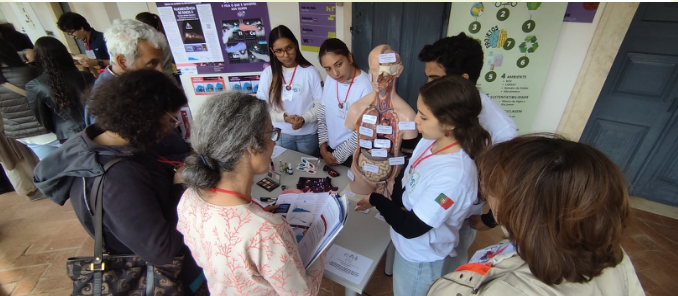
Picture: Students’ participation at the National Congress “Cientistas em Ação”.
Outcomes
This OSA yielded significant scientific and educational outcomes that exceeded initial expectations. Students successfully mastered advanced analytical chemistry concepts, gaining a practical understanding of X-ray fluorescence spectroscopy principles typically reserved for university-level courses. They developed sophisticated research skills, including literature review techniques, experimental design, and statistical analysis of spectroscopic data.
The activity’s key scientific finding challenged conventional assumptions about cosmetic product quality. Students discovered that no significant differences existed between expensive and inexpensive cosmetic brands regarding heavy metal content, contradicting widespread beliefs that premium products offer superior safety. Importantly, highly toxic metals, including lead, mercury, cadmium, and chromium were not detected in the analysed samples, suggesting adequate regulatory protection while emphasising the continued need for rigorous standards across all brands.
Students successfully presented their research at the 18th National Congress “Cientistas em ação” (Scientists in action), demonstrating enhanced scientific communication skills and confidence in engaging with the broader scientific community. The project integrated scientific knowledge acquisition with citizen education, developing collaborative skills, scientific writing abilities, and critical analysis competencies that are transferable across academic disciplines and future professional contexts, while fostering a lasting understanding of the intersection between scientific research and civic responsibility.
Reflective remarks
The activity’s impact extended far beyond initial expectations, demonstrating how authentic scientific research can transform student understanding of both academic content and their role as informed citizens. Students successfully acquired advanced knowledge of analytical chemistry techniques, toxicology principles, and public health concepts while developing sophisticated critical thinking skills that challenged their assumptions about consumer product safety. The activity’s findings that expensive cosmetic brands do not necessarily offer better safety profiles than inexpensive alternatives provided students with powerful evidence of the importance of scientific investigation over marketing claims and social assumptions.
The interdisciplinary nature of the OSA created meaningful connections between Chemistry, Biology, and public health that students had not previously experienced, demonstrating how scientific knowledge integrates across traditional academic boundaries to address real-world problems. Students developed a genuine appreciation for the complexity of consumer product regulation, the importance of rigorous testing, and the role of scientific research in protecting public health. Their presentation at the national scientific congress provided validation of their work and confidence in their ability to contribute meaningfully to scientific knowledge and public discourse.
For future implementations, several key improvements would enhance the activity’s impact and accessibility. Beginning the OSA earlier in the academic year would provide more flexible timing and reduce conflicts with examination periods and other academic pressures. Expanding the partnership model to include additional universities and research institutions would create more opportunities for schools to access advanced analytical equipment and expert mentorship. The development of simplified analytical techniques that could be partially conducted in school laboratories would make similar projects more accessible to schools without university partnerships. Assessment frameworks should be developed that specifically recognise students’ development of scientific research skills, critical thinking abilities, and science communication competencies alongside traditional academic content mastery. The activity’s success in connecting academic learning with authentic scientific investigation and social responsibility should be replicated across other environmental and health-related topics, creating a systematic approach to OSA that prepares students for active citizenship in an increasingly complex technological society.
