Basic Information
- Interdisciplinarity: Chemistry, Biology, Biomedicine
-
Topic(s): Digitalisation / Green Deal
- Duration: 500 minutes
- Target Age Group: 16–20 years old
- Partners Involved: IE-ULisboa, AE Alfredo da Silva
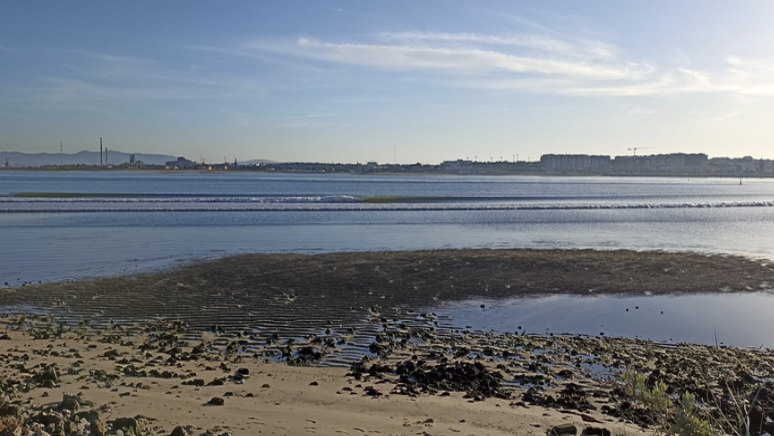
Picture: Alburrica’s Beach, Barreiro.
Summary
This OSA aimed to help students understand environmental monitoring through hands-on scientific investigation, AI-assisted research, and laboratory analysis techniques. Students explored water quality parameters including temperature, pH, salinity, nitrites, and ammonia by collecting samples from the Tagus River estuary adjacent to their school in Barreiro. Using artificial intelligence tools like ChatGPT, Perplexity, andMachine Learning platforms with decision tree models, they researched reference values, validated analytical methods, and classified water samples as “healthy” or “polluted.” The activity promoted critical thinking about AI reliability, environmental awareness, and professional laboratory skills while integrating Physics and Chemistry,Chemical Analysis, and Chemistry Safety and Environment curricula across 11th and 12th grade levels of the vocational course of Laboratory Analysis Technician.
Description of the implementation process of the activity
Planning: The activity was designed following a training session on AI applications in scientific education led by a member of the IE-ULisboa. Three teachers collaborated to integrate content from Physics and Chemistry (FQ), Chemical Analysis (AQ), and Chemistry, Safety, and Environment (QSA) subjects across 11th- and 12th-grade classes.
Research Phase: Students worked in groups of 3-4 elements to research reference values for estuarine water parameters using AI tools, including ChatGPT and Perplexity. Initial research covered pH, nitrates, nitrites, chlorides, salinity, temperature, dissolved oxygen, and conductivity. Based on research findings and available laboratory equipment, the scope was refined to focus on temperature, pH, salinity, nitrites, and ammonia.
Field Work: Due to the school’s proximity to the Tagus River, water sampling and in-situ parameter measurement (pH and temperature) were conducted during QSA classes. Students collected samples directly from the estuary surrounding the school.
Laboratory Analysis Phase: In AQ classes, students performed various analyses on collected water samples using volumetric and potentiometric techniques, including acid-base, oxidation-reduction, and precipitation titrations.
AI Integration: Students used Machine Learning platforms with decision tree models, training algorithms to distinguish between “polluted” and “healthy” water based on parameter studies from estuarine waters.
Assessment: The project concluded with an AI-assisted evaluation of water quality from samples collected in the Tagus estuary near the school.
Communication: The OSA culminated in a final school exhibition, where students presented their findings to fellow students, teachers, and parents, demonstrating their research process, laboratory techniques, and AI-powered analysis results.
Strategies to win schools
The project leveraged several key engagement strategies to ensure successful school and teacher participation. Initially, teachers were offered a professional development program on OSA, providing them with theoretical foundations and practical implementation strategies, along with ongoing support throughout the OSA implementation process to ensure successful execution.
This professional development approach was complemented by strategic curriculum integration, as the activity seamlessly aligned with existing curriculum requirements across multiple subjects, including Physics and Chemistry, Chemical Analysis, and Safety and Environment, making participation valuable for students, while supporting their preparation for professional internships and final assessments.
The choice of studying the Tagus estuary water quality created strong local relevance that resonated with students due to the school’s location and the area’s remarkable environmental transformation. Students could personally relate to the improved water quality that now allows recreational activities like swimming, contrasting sharply with the historical pollution from nearby industrial facilities such as the former Quimigal chemical plant.
This local connection was enhanced through technology integration that incorporated AI tools including ChatGPT, Perplexity, and Machine Learning platforms, appealing to students’ interest in digital technologies while developing critical digital literacy skills. Rather than isolated subject learning, the project employed a genuine interdisciplinary approach where students experienced authentic horizontal and vertical curriculum articulation, seeing practical connections between theoretical concepts and real-world applications. This was supported by an active learning methodology that employed inquiry-based learning with real socioscientific questions, moving decisively away from traditional lecture-based instruction to engage students as active knowledge constructors in their own learning process.
Schools support
Comprehensive support was provided to participating schools throughout the implementation of the OSA. The support began with a structured professional development program on OSA, providing teachers with theoretical foundations, pedagogical approaches, and practical implementation strategies for OSA. This initial training was complemented by ongoing mentoring support throughout the project duration. Technology support formed a crucial component of the assistance provided, including training on artificial intelligence tools and platforms. Teachers received guidance on integrating ChatGPT and Perplexity for research activities, along with instruction on Machine Learning platforms utilising decision tree models for water quality classification.
Ongoing communication and mentoring were maintained through regular sessions with project members, who provided specialised expertise in AI tool applications for scientific education. This mentoring relationship proved essential when students encountered research challenges, particularly in finding appropriate reference values for estuarine water parameters. Communication channels remained open throughout the project, allowing teachers to seek guidance on pedagogical challenges, technical difficulties, and implementation adjustments as needed.
Key-success factors
The success of the implemented activity was a result of several factors that worked together to create an engaging and effective learning environment. Strategic curriculum integration proved fundamental, as the seamless connection of multiple subjects into a unified objective created a genuine interdisciplinary learning experience that motivated students across both 11th and 12th grade levels. This integration enabled students to experience authentic horizontal and vertical curriculum articulation, allowing them to see practical connections between theoretical concepts and real-world applications, rather than learning subjects in isolation.
The local environmental connection provided exceptional engagement through the project’s focus on Tagus estuary water quality, which created profound personal relevance for students. The transformation of Barreiro from an industrially polluted area where the former Quimigal chemical plant had degraded water quality to a location where students can now safely swim during lunch breaks provided meaningful context and ownership of the learning experience. This connection to their immediate environment made abstract scientific concepts tangible and personally significant, driving sustained student motivation throughout the project duration.
Technology integration was carefully balanced to enhance rather than replace critical thinking skills, with the thoughtful incorporation of AI tools, developing sophisticated digital literacy while maintaining analytical skepticism. Students learned to question and validate AI-generated responses, transforming from passive consumers to critical evaluators of digital information. The collaborative teaching approach involving three coordinating educators across multiple subjects enabled efficient progress and comprehensive student support, while the shift from traditional teacher-centered instruction to student- centered inquiry-based learning significantly increased engagement and motivation. The connection to authentic professional preparation through internship readiness and final assessment skills, combined with adaptive problem-solving that allowed scope adjustments based on research findings and available equipment, maintained project momentum despite implementation challenges while ensuring educational value remained high throughout the process.
Challenges
The implementation encountered several significant challenges that required adaptive solutions and strategic problem-solving throughout the OSA duration. Research difficulties emerged as the most prominent initial obstacle, as students struggled to find appropriate reference values for estuarine waters when conducting their AI-assisted investigations. Search queries typically returned drinking water quality standards or upstream/downstream monitoring data rather than the specific estuarine ecosystem parameters required for the OSA. Even when using familiar tools like ChatGPT, students found that obtaining relevant reference values demanded multiple search strategies, varied terminology, and sophisticated query refinement techniques that exceeded their initial digital research capabilities.
Equipment limitations presented another substantial challenge, as the school’s laboratory resources constrained the number of water quality parameters that could be reliably analyzed compared to the project’s initial scope. While students had initially planned to examine a comprehensive range of parameters including pH, nitrates, nitrites, chlorides, salinity, temperature, dissolved oxygen, and conductivity, the available analytical equipment necessitated focusing on a more limited set of measurable parameters. Time management emerged as the third major challenge due to the compressed implementation timeline, with students beginning internships in mid-May, Easter break occurring from April 7-21, and the project commencing in mid-March, leaving an extremely limited window for comprehensive implementation.
These challenges were systematically addressed through collaborative problem-solving and adaptive pedagogy. The research difficulties were resolved through the intervention and collaboration of project members, who introduced Perplexity as a more effective AI research tool and provided guidance on advanced search strategies and terminology refinement. Equipment limitations were managed by strategically narrowing the project scope to focus on temperature, pH, salinity, nitrites, and ammonia – parameters that could be accurately measured with available resources while maintaining educational value and scientific rigor. The time constraints were overcome through intensive collaborative teaching involving three coordinating educators working simultaneously across multiple integrated subjects and two class groups, enabling accelerated progress and maximising weekly advancement. This collaborative approach, combined with careful project management and flexible scheduling, enabled the successful completion of the project by mid-May, despite the compressed timeline, demonstrating that strategic adaptation and teamwork could overcome significant logistical challenges.
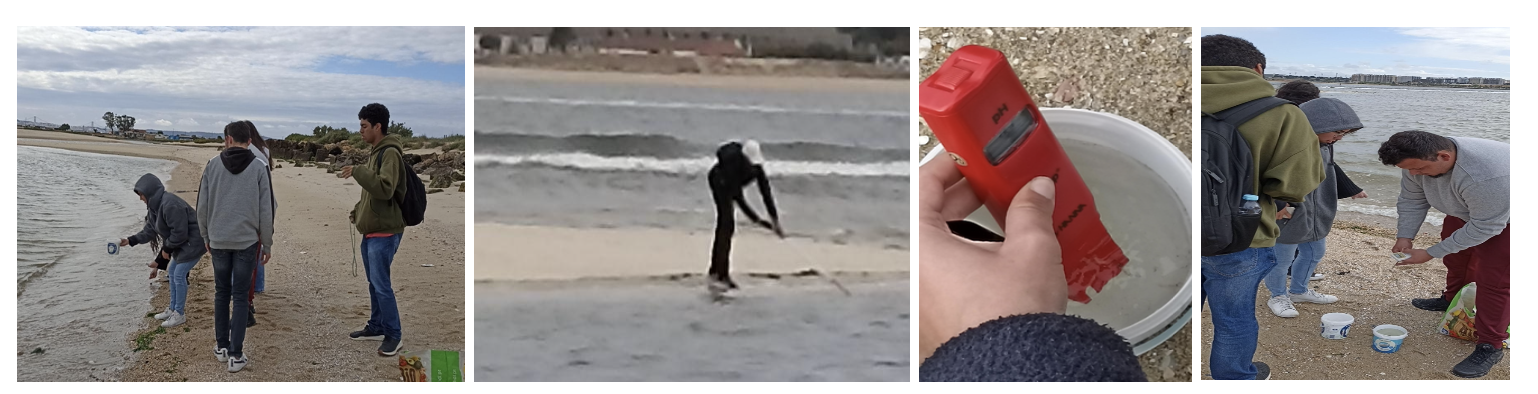
Picture: Water sampling and monitoring.
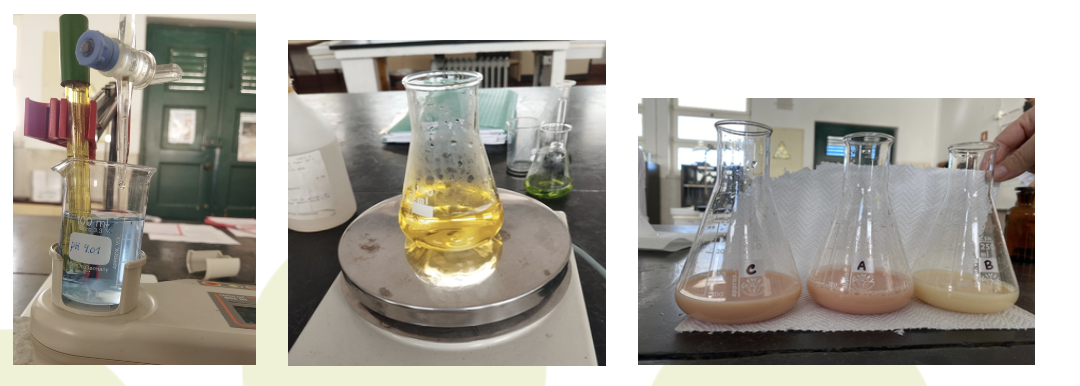
Picture: Water analysis.
Outcomes
The implementation of this OSA yielded comprehensive educational and personal development outcomes that exceeded initial expectations across multiple domains. Students successfully completed all academic learning objectives related to chemical equilibrium, acid-base reactions, oxidation-reduction processes, precipitation reactions, and analytical laboratory techniques, while simultaneously developing advanced digital literacy capabilities that transformed their approach to information validation and the utilisation of artificial intelligence. The integration of AI tools throughout different project phases enabled students to experience critical analysis perspectives they had not previously encountered, moving from an initial conception of AI as an unquestionable information source to recognising it as a useful but fallible tool requiring continuous critical oversight and validation. Student feedback consistently highlighted the transformational nature of the learning experience, with participants expressing appreciation for discovering that “AI doesn’t always give the right answers and we need to think critically”, understanding how “seeing our own river’s water quality improve made the chemistry real”, and recognising that “working across different subjects helped us understand how everything connects”. These insights demonstrate the project’s success in developing both analytical
thinking skills and personal environmental consciousness. The practical application of Machine Learning platforms with decision tree models provided students with hands-on experience in data classification and algorithmic thinking, while the comprehensive analysis of five water quality parameters using professional laboratory techniques enhanced their technical competencies and preparation for professional internships. Measurable outcomes included 100% student completion of water quality assessments using Machine Learning platforms, successful field sampling and laboratory analysis of temperature, pH, salinity, nitrites, and ammonia parameters, and demonstrated improvement in collaborative problem-solving and scientific communication abilities. The final school exhibition where students presented their findings to peers, teachers, and parents showcased their enhanced confidence in public presentation and their ability to communicate complex scientific concepts to diverse audiences. The project’s interdisciplinary nature successfully connected theoretical classroom learning with authentic environmental investigation, creating transferable skills applicable across academic and professional contexts while fostering genuine environmental stewardship attitudes that extend beyond the immediate educational experience.
Reflective Remarks
The OS activity’s impact exceeded initial expectations in developing both disciplinary knowledge and transversal competencies. Students successfully acquired targeted learning outcomes in chemical equilibrium, acid-base chemistry, oxidation-reduction processes, and analytical techniques while simultaneously developing crucial digital literacy skills that transformed their relationship with artificial intelligence tools. The project demonstrated that students could move beyond passive consumption of AI-generated information to become critical evaluators who actively validate sources, question responses, and maintain analytical scepticism. This transformation proved particularly valuable given the increasing prevalence of AI in educational and professional contexts.
Environmental awareness emerged as a significant outcome, with students developing genuine ownership of their local ecosystem’s health through direct engagement with the Tagus estuary’s environmental transformation. The connection between historical industrial pollution and current water quality suitable for recreational use provided powerful context for understanding environmental recovery and stewardship responsibilities. Students demonstrated increased environmental consciousness that extended beyond the classroom, evidenced by their continued interest in local water quality monitoring and broader sustainability issues. For future implementations, several key recommendations emerge from this reflective analysis. Beginning implementation at the academic year’s start would provide better time management flexibility and allow for more comprehensive community engagement, potentially including partnerships with local environmental monitoring agencies and municipal authorities. The AI literacy development component should be expanded and formalized with specific assessment rubrics that can evaluate students’ critical evaluation skills alongside traditional academic outcomes. The interdisciplinary methodology proved highly transferable and should be adapted to other environmental topics, educational levels, and geographic contexts while maintaining the core elements of local relevance, technology integration, and authentic scientific investigation. Long-term sustainability requires institutionalising this approach within the school’s permanent curriculum structure, ensuring that future student cohorts can benefit from similar integrated learning experiences that connect academic content with real-world applications and emerging digital technologies.
