
Basic Information
- Interdisciplinarity: Technology, Engineering, Computing
- Topic(s): Digitalisation / Green Deal
- Duration: 6 months
- Target Age Group: 14–15 years old
- Partners Involved: Elementary School Josip Pupačić Omiš, Centre of excellence Splitsko-dalamtinska county, Communal enterprise Peovica, architect Ivona Buljević
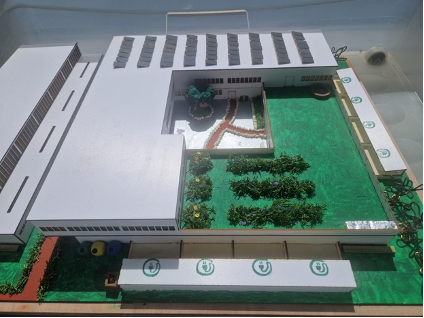
Picture: 3D Model
Summary
In this activity, a group of students, supported by two teachersrtners, decided to design a vision and a model o and external paf a new sustainable building for their school. The aim of the project is to create a sustainable, green, and technologically advanced school that will contribute to transforming the town of Omiš and provide concrete suggestions for a new project considered by the town council. This is an interdisciplinary project through which the students have learned various STEM subjects and have been involved in reflecting on and connecting their acquired knowledge, as well as developing new skills.
Description of the implementation process of the activity
The activity was carried out over six months. First, a project team was formed, including students, teachers, experts in sustainability and ecology, as well as architects. The team started the activity by setting goals and defining key milestones. Additionally, a connection to the communal enterprise Peovica and local community environmental associations was established in the first month. In the second month, the students familiarised themselves with 3D modelling and design using Minecraft. A survey was conducted among the students and local residents living near the school. The students gathered the necessary materials for the 3D model and discussed ecological issues to be addressed, such as energy solutions, the shape and position of the building, building materials, and protecting ecosystems and biodiversity.
In the third month, the students began building the 3D model and worked on its details. Collaboration with architects and sustainability experts ensured quality assurance. In the fourth month, a model of the school was created in Minecraft. The process was monitored by taking photographs of the model at each stage and creating a video. The 3D model was completed in the fifth month, after which students prepared a presentation of the project. In the sixth month, the activity was first presented at the school (to selected parents and teachers) and then at the ICSE Science Factory School Fair.
Strategies to win schools
This activity was initiated by enthusiastic teachers and motivated students. The project idea was developed collaboratively by students and teachers without any external motivation. It focuses on urgent issues faced daily by students and teachers: the school operates at two locations, where there is insufficient infrastructure to meet 21st-century educational needs. The plan is to base the project on green ideas that are both attractive and functional, such as planting vegetation on the school’s roof so that Mediterranean plants and herbs grown there cantchen. Smart systems help save energy and enhance students’ lifestyles, while smartboards, interactive screens, and wireless internet improve teaching and learning processes. A also be used in the school’s kill these benefits are immediately of interest to students, and their value is also recognised by the local community, including students’ families.
Schools support
The school has established a strong collaboration with the communal enterprise, local architect, and sustainability experts – each of these partners has provided valuable education and advice to students and teachers. The students have learned how to build 3D models, how to model using Minecraft, and how to reason about sustainability and functional design. The education took place in the school as the external experts visited the school team and worked with them on the design.
Key-success factors
The success of the project also depends on the experience of the teachers, the support of the school principal, engagement of external experts, and the local relevance of the idea. It is very important that the teachers have experience with project-based teaching and value students’ ownership in the activity process.
The experience that the teachers have gained from their previous projects has been crucial for raising students’ interest, planning, and coordination. The teachers have assisted students in resource management and communication with external partners. The relevance of the project idea has also proven to be very important in attracting quality external partners who have agreed to volunteer in this collaboration with the students.
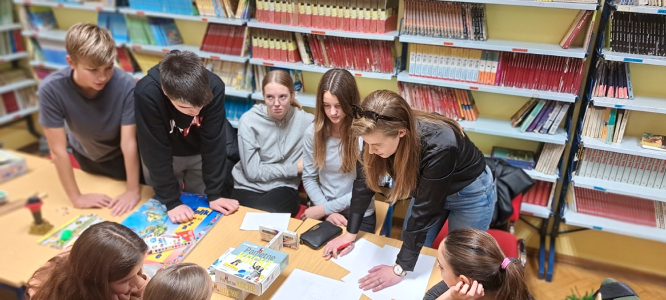
Picture: Meeting with the architect, Mrs. Ivona buljević
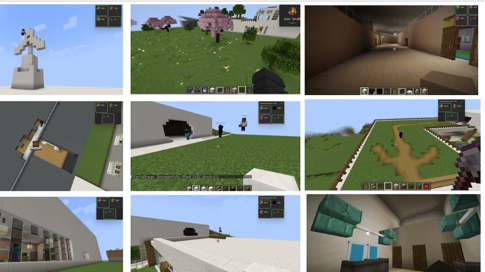
Picture: MINECRAFT I ROBLOX
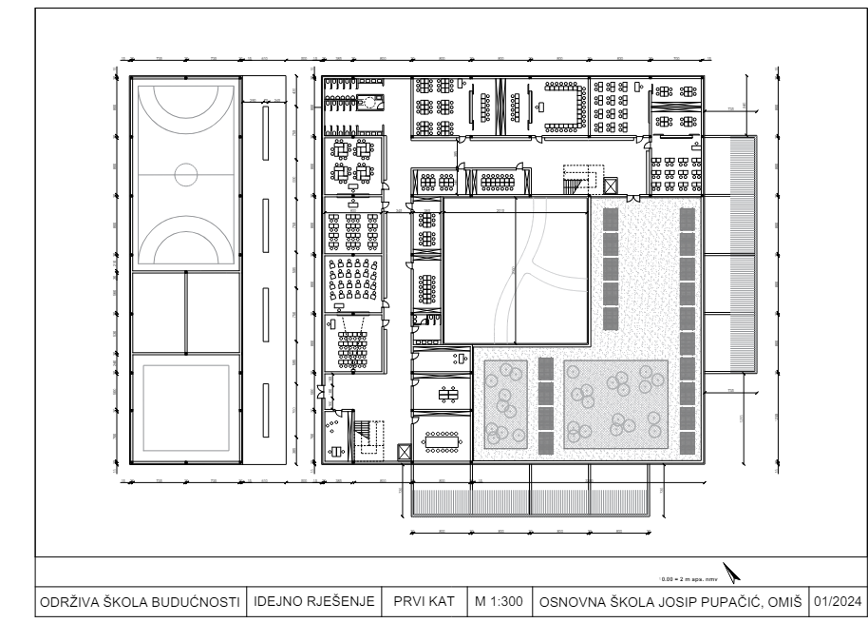
Picture: AutoCAD
Outcomes
In this project, the students have developed a vision, a design, a virtual model, and a 3D concrete model for a sustainable school of the future. Through this activity, students have learned how to think about sustainability topics in a context that is very close to and important for them. The project results have been presented to the local community (parents and others in the school) and to the Croatian partners in the consortium. The presentation has been evaluated, and the activity has been recognised as the best project at the national ICSE science fair. This confirms the high quality of the outputs.
Challenges
The biggest challenge of the project is its professional complexity. This has been balanced by allowing more time for implementation (6 months) and by setting realistic goals (a vision presented through a 3D model). Although the students’ design might not be used directly in the development of the new school building, the project was very successful in providing students with a valuable hands-on learning experience. It also raises awareness among local authorities about the issue and the potential solutions that can be developed (at least partially) even by students.
There were several risks, such as students becoming demotivated or discouraged by the slow pace of the administrative system, a lack of understanding from local authorities, or the complexity of the task. It is commendable that the students persisted and implemented a variety of activities demonstrating very different skills (such as abstract reasoning, building tangible models, and giving presentations).
Reflective remarks
The sustainable school of the future was a highly successful project that integrated various aspects of engineering, science, environmental studies, and active citizenship. Such an interdisciplinary approach relies on many interactions between students, STEM teachers, and different experts, providing numerous learning opportunities. The main advantage of the project is that students and teachers are motivated to conduct research on a problem that is so close and relevant to them. Because of these aspects, the ICSE Factory team in Croatia considers this project a flagship activity of open schooling and awarded the school team as the best open-schooling activity at the national science fair. We believe that the high quality of the results and the creative presentation will encourage other schools to engage similarly.
