
Basic Information
- Interdisciplinarity: Technology, Design, Engineering, Physics
- Topic(s): Digitalisation
- Duration: 3 months
- Target Age Group: 14–16 years old
- Partners Involved: ICSE, Marie-Curie-Gymnasium Kirchzarten
ć


Summary
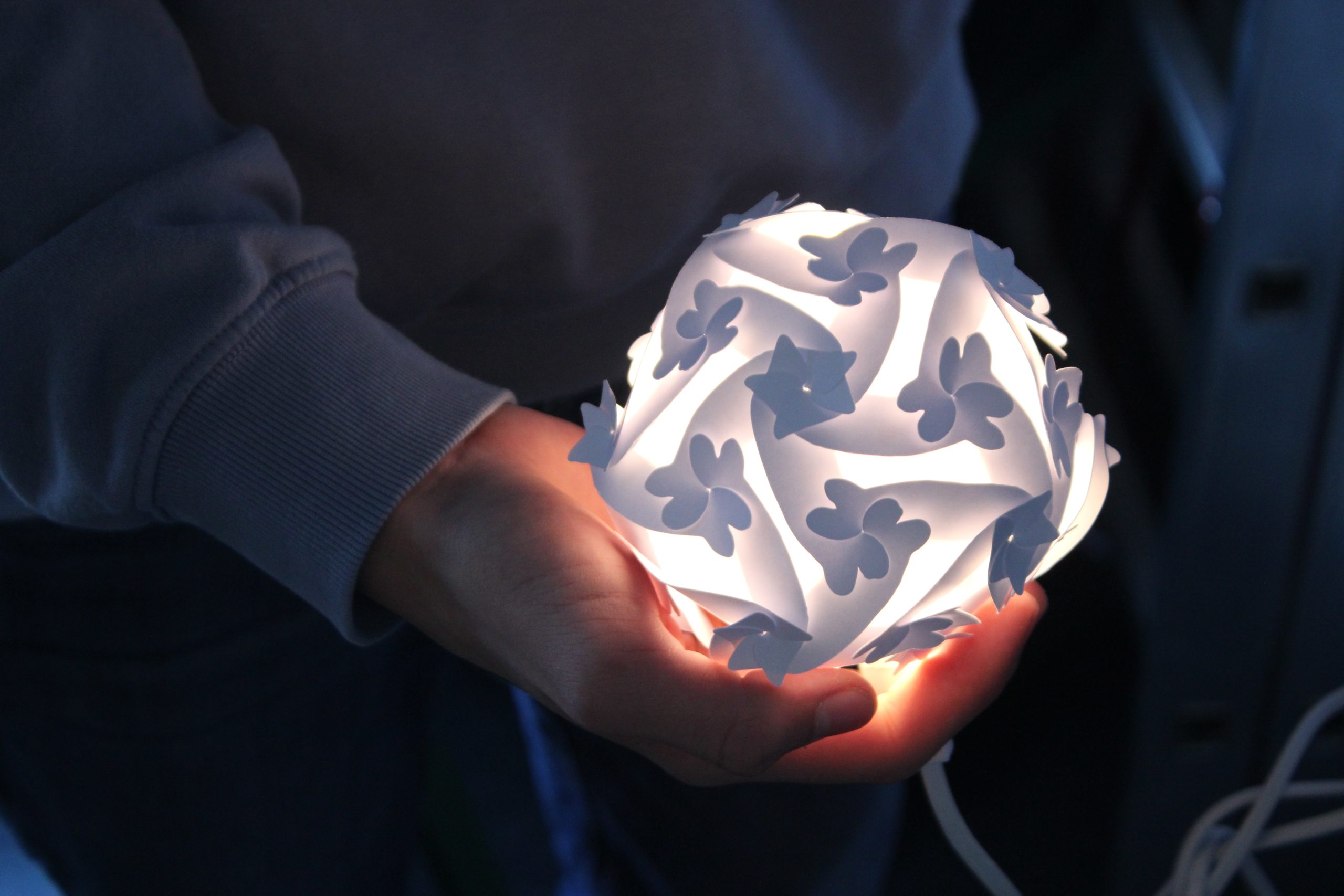
In groups of 1-3, students from a maths club designed their own new versions of “puzzle lamps”, i.e., spherical lampshades assembled from many identical parts without glueing. The basis for this was the mathematical analysis of existing commercial designs. The tool they used was a plotter, which can digitise and edit hand-drawn shapes and cut them out in large quantities.
Description of the implementation process of the activity
The math club at the Marie-Curie-Gymnasium Kirchzarten meets on Saturday mornings throughout the year. The main part of the project therefore took place on two consecutive Saturday mornings. As the plotter was a bottleneck, the number of participants was actually limited to 8, but another pupil was keen to take part, so there were 9 pupils. The mathematical basics and analysis of the existing designs took about 90 minutes, and the students spent the rest of the first morning developing their first prototypes. In a first step, it was enough to plot just a few parts to see if the basic shape and the connections between the parts worked. These were then adapted, and decorative elements were added and optimised. It usually took about 3-4 iterations from prototypes to the final design. To avoid congestion at the plotter, mass production of the parts mainly occurred not on the two Saturday mornings, but in the time in between and afterwards. The groups then completed their designs during the second Saturday. For the following three months, the plotter remained at the school and was always accessible to the students so they could make further copies of their lamps.
The students presented their designs to their parents, classmates and the public at the ICSE Science Factory fair on 14.2.25. In addition to the finished lamps, visitors were also able to see how the plotter works and understand the mathematical principles of the designs on a poster.
Strategies to win schools
Through personal contacts, we learned that there is a math club at this school and then wrote to the teacher in charge of this club to ask if he could imagine the topic for the math club. As he found the topic exciting, he agreed and advertised the project in his math club and easily found enough young people who wanted to take part. In our experience, it is easier to convince teachers and students on a content level by talking about what a project could look like in terms of content, rather than about the general concept of open schooling. We also promoted the same project via posters, flyers, our newsletter, at a convention with the partner schools and at a public science festival, but nothing came of it.
Schools support
A scientist from ICSE visited the math club on two consecutive Saturdays for one morning each. She explained to the students what Catalan solids are and brought lots of pictures of different puzzle lamps which the students analyzed (looking at the aspects of underlying solids, connections and ornamentation). She also brought a plotter that can be used for scanning and cutting and showed the students how to use it. The plotter remained at the school for three months from the start of the project. In addition to the plotter, ICSE also provided all the necessary materials (thick paper, lamp blanks, pens). On the two Saturdays, the young people received support with the iterative design of their lamps on request, but they actually worked very independently and hardly needed any help. On the second morning, the ICSE employee brought some input on the mathematical background, which was not absolutely necessary for the development of the design, but in which the students had shown a particular interest on the first Saturday. After that, hardly any support was needed, only organizational preparation for the fair and the subsequent extraction of the files from the plotter in order to use them later with the school’s laser cutter. The students created the poster for the fair independently without the help of ICSE.
During a break caused by a bottleneck at the plotter, a group of students asked themselves how to distribute lamp parts in three different colors so that parts of the same color are not next to each other and the colored lamp has as much symmetry as possible. Afterwards, the mathematician analyzed the colored lamp developed by the group and gave the students the feedback that they had indeed found the best solution for such a coloring.
Key success factors
- It was crucial for the success of the project that enough time was set aside for it. Through the existing math club, it was already established that students take several Saturday mornings for something like this. It would probably also be possible to implement it as part of project days, for example. It would be inconceivable to implement this in the normal classroom.
- The students were highly motivated. If they hadn’t chosen the topic themselves, they certainly wouldn’t have been.
- The teacher in charge of the math club found the topic so exciting that he was willing to organize the project (including a visit to the trade fair), even though he had not worked with us before


Outcomes
- One pupil said after the first Saturday session: “I’m very glad I didn’t go to my confirmation preparation instead
- When a student learned that ICSE cannot run the Open Schooling project at the school every year from now on because the ICSE Science Factory only lasts 3 years, he said “Tell the EU that this project should be continued. It’s a good project!”
- The poster that the students created for the fair has been hanging in the school ever since. The teacher who runs the math club says he is often asked about it.
- The school recently acquired a laser cutter. It was purchased by a teacher who is not involved in the math club. So far, however, it has not been used. At the moment, the plan is to use the laser cutter to convert the lamp designs into plastic, which is not possible with the plotter.
- A report on the project is planned for the school’s homepage.
- ICSE presented a poster session on the project at the international conference “Creative Mathematical Sciences Communications”.
- ICSE contributed an article and a presentation to the international conference “Bridges” in which the design process and results were presented, which can be found here: https://archive.bridgesmathart.org/#gsc.tab=0
- ICSE submitted an article to the German magazine for STEM teachers “MINT-Zirkel” on what puzzle lamps have to do with mathematics and how they can be used in the classroom.
Challenges
- The questionnaires at the beginning of the project are long and repetitive. This makes the students suspicious of the Open Schooling project at first, as they suspect that the project content might be similarly boring. We therefore apologized when we handed out the questionnaires and promised that it would be more interesting afterwards. However, shorter questionnaires would of course be better.
- As the students have a lot of freedom, they may not end up with a working design. In fact, the teacher in charge of the math club was a little worried at the beginning about whether they were up to the project. We responded to this in two ways: Firstly, it was important for us to emphasize that it is normal in projects (just like in research) that you don’t know at the beginning whether it will work or what the end result will be. We invited them to take this risk and, in the event that their own design could not actually be made to work with the effort they could justify , to plot an existing design at the end. Secondly, we have pointed out that they can manage the risk of failure themselves: A relatively safe way to create your own working design is to simply make variations in the decorative elements on an existing design. Even small changes can create major visual variations. In addition, the selection of the basic body, which determines the number of parts, can be used to determine how complex it is to assemble the final lamp, as well as the respective prototypes beforehand. In fact, one student opted for a basic body with a large number of parts and a design that was not related to the ones we had already analyzed. Although he developed a working design, he lost the desire to finish assembling the final version along the way. However, as he seemed satisfied overall, we saw no reason to intervene. Everyone else completed at least one of their own designs.
Reflective remarks
We think that the project was an experience of self-efficacy for the students, in which they independently created something beautiful with the help of mathematics that did not exist before. The fact that success was not guaranteed at the beginning enhanced this experience.
However, the conditions were very good: the students were highly motivated right from the start and the organizational framework of the math club provided sufficient time and a pleasant working atmosphere. It is not clear how well the success of the project could be repeated in more difficult conditions.
It turned out that the topic offers plenty of scope for students to find and work on mathematical questions spontaneously, such as possible distributions of colors, for which the young people received no input at all and still developed their own questions, hypotheses and solutions. This is certainly a great advantage of this topic and was surprising for us to this extent.
It would certainly have been nice to use the project to introduce the young people to the maker community. We didn’t manage to show the young people platforms such as Thingiverse, where designs such as the cut files of their lamp parts can be shared, in the time we had available as part of the working group. It would also have been nice to use the lamps at a larger celebration or an Advent bazaar or another event at the school, for example. However, this would have been an additional organizational effort for the supervising teacher , who has already invested many hours of his free time in the project and the subsequent visit to the fair.
Through the two publications on the topic (see below), we hope that motivated teachers will be able to carry out similar projects in the future without our help – either as part of a working group, as in our case, or as a project by individual students, as is the case in Germany, for example, in many grades and types of schools, where all students work on a freely chosen topic.
